“AI agent” is one of the most talked-about terms in business technology right now, and one of the least explained. This guide cuts through the hype: what an AI agent actually is, what it can do in a small business, and how to use one without losing control.
What is an AI agent?
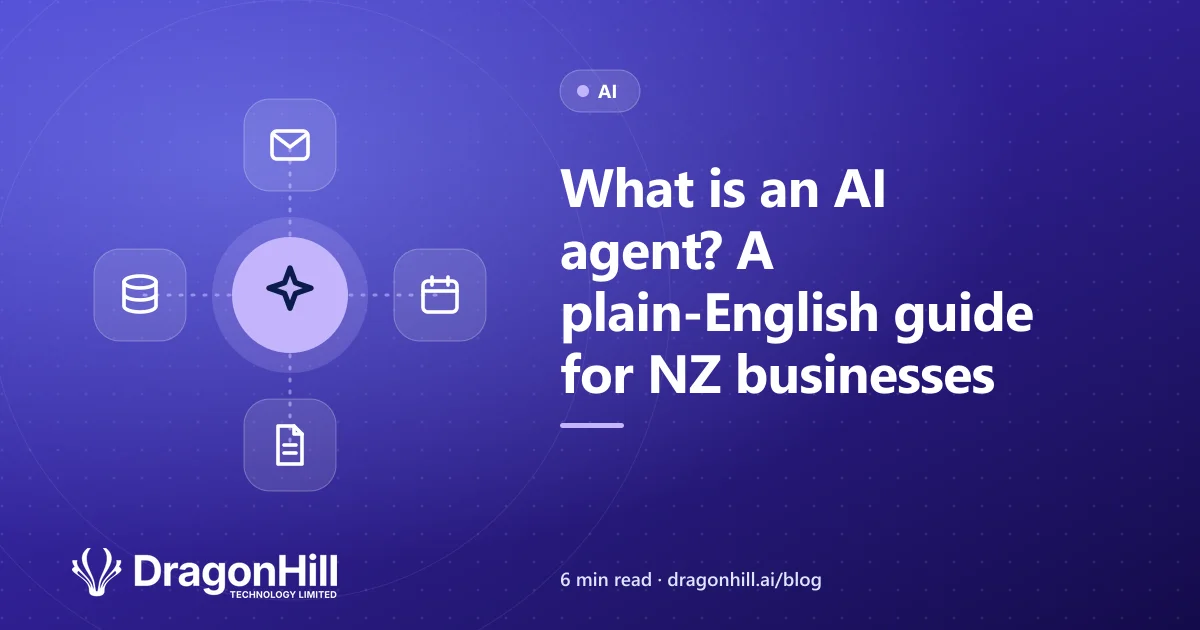
An AI agent is software that uses AI to carry out a task on your behalf, not just answer a question. It reads information, decides what to do next based on your rules, uses your tools to do it, and reports back.
A useful way to think about it:
- A search engine finds information.
- A chatbot answers questions in conversation.
- An AI agent does a job: it can draft a quote, update your CRM, code a bill in Xero or book an appointment.
AI agent vs chatbot
| Chatbot | AI agent | |
|---|---|---|
| Main job | Answer questions | Complete tasks |
| Uses your systems | Rarely | Yes, through their APIs |
| Takes actions | No | Yes, within limits you set |
| Needs approval | Not usually | Should, for anything important |
Many businesses start with a chatbot and soon find the real time savings come from agents that do the follow-up work.
What an AI agent can do in a small business
Common examples we see:
- Answering customer questions from your own information, around the clock.
- Drafting quotes from enquiries and your price list.
- Following up open quotes at the right time.
- Reading supplier bills and coding them in Xero the way you do.
- Summarising documents such as leases and contracts.
- Weekly reporting pulled from several systems.
For a longer list, see 10 admin jobs an AI agent can take off a small business.
Why “dedicated” agents work better
Off-the-shelf AI tools are general. A dedicated AI agent is designed for one job in your business, trained on your own information and connected to your own systems. That focus makes it:
- More accurate, because it only has to do one thing well.
- Easier to test, because you know exactly what good looks like.
- Easier to trust, because its limits are clear.
Keeping a person in charge
The agents that work best have clear limits:
- Approval for anything important. Sending money, changing prices or emailing a new customer should wait for a person.
- A record of every step, so you can see what the agent did and why.
- Limited access. The agent only sees the systems and data it needs.
- Business-grade AI services that don’t train on your data.
How to get started
- List the repeat tasks your team does every week.
- Pick the one that costs the most time and has clear rules.
- Start small, measure the time saved, then expand.
If you’re not sure where AI fits, start with automation: our guide to the first business processes to automate covers tasks that don’t need AI at all.
More in this series
- 10 admin jobs an AI agent can take off a small business
- AI chatbots for customer service: what works in 2026
- Is your data safe with AI? A checklist for NZ businesses
- 8 business processes to automate first
Thinking about an AI agent for your business? We design and build dedicated AI agents for NZ and Australian businesses. Discuss your AI agent in a free 30-minute call.